Life of Khalid Bin Waleed
by
Muhammed Qasim Rabbani
The story follows Khalid bin Walid, a formidable general known for his unmatched prowess in battle, as he grapples with his identity and faith. Through introspection and dialogue with allies and forme...
Contents
4,462 words · 4 chapters · 1 characters
Chapter
01
The Siege of Medina
Chapter 1 · Scene 1
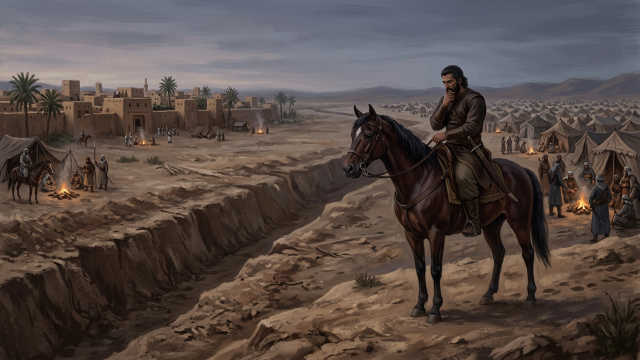
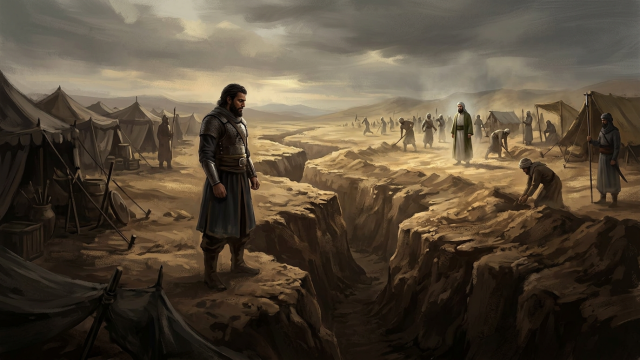
The air around Medina tasted of dust and tension. For twenty long days and nights, the city had been under siege. A vast confederacy of enemies—ten thousand strong—had marched to wipe the nascent Muslim community from the face of the earth. They were stopped not by a wall of stone, but by a trench, a Persian-style defense dug on the advice of Salman the Persian. It was a tactic utterly alien to the Arabs of the desert. On the other side of that trench, frustration festered like an open wound. And no one felt that frustration more keenly than Khalid bin Walid. He sat astride his horse, his dark eyes scanning the seemingly impassable ditch. He was the greatest general Arabia had ever produced. He had never known defeat. His name alone was enough to send a chill down the spine of any foe. And yet, here he was, camped with the Quraysh and their allies, staring at a ditch. They couldn't cross it. Their horses, the very instruments of their power, were useless against it. They had resorted to taunts, to archery duels, to waiting. It was beneath him.
Chapter 1 · Scene 2
Khalid was a man of action, of fire and blood and the terrifying, glorious chaos of the charge. This static waiting gnawed at his soul. He would watch the Muslim defenders on the other side, and his gaze would inevitably find one man. A man who wasn't fighting, but organizing, praying, and inspiring. Muhammad, the Messenger of God. From his position among the Quraysh, Khalid had heard the descriptions: a sorcerer, a madman, a poet. But from across the trench, he saw none of that. He saw a leader whose authority was not born of a tribe or a sword, but of something far more profound. He saw men who, just a few years prior, were his own kin and allies, now willing to die for this man and his singular message: La ilaha illallah (There is no god but Allah). A thought, sharp and unwelcome, pierced his mind. What if he is right? He shook it away. He was Khalid bin Walid. He was here to fight.
Chapter 1 · Scene 3
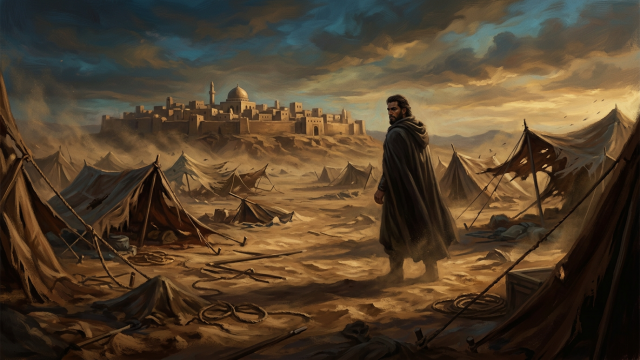
Then came the night of the storm. A howling, freezing wind from the desert tore through the confederate camp. It snuffed out their cooking fires, sent their tents flying like panicked birds, and filled the air with biting sand. In the chaos, the alliance crumbled. The different tribes, suspicious and weary, abandoned the siege, melting away into the darkness. By morning, the vast army was gone. The siege was over. The Muslims had won without a single major battle. As the Quraysh forces retreated, Khalid lingered for a moment, looking back at the city he had failed to conquer. He didn't see a military defeat; he saw a divine sign. The storm, the wind, the collapse of the alliance—it felt too perfect, too purposeful. A powerful, unnamed emotion churned in his chest, a mixture of humility and wonder he had never felt on any battlefield.
Chapter 1 · Scene 4
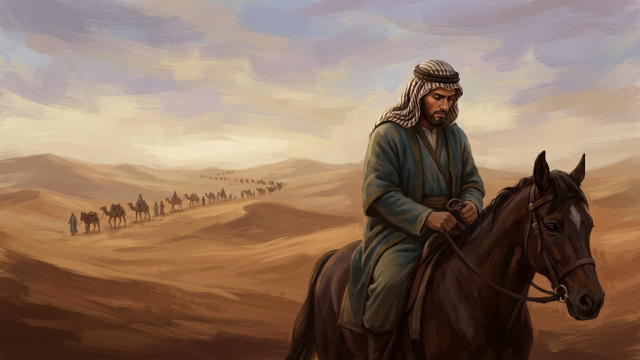
The journey back to Mecca was a long one. Khalid was silent, his thoughts a battlefield of their own. He was a man who had built his identity on his prowess, his loyalty to his clan, and his enmity towards Muhammad. To question that was to question himself. Not long after, the Treaty of Hudaybiyyah was signed. A ten-year truce was established. It was a strategic victory for the Muslims, a peace that allowed them to grow. For Khalid, it was a period of agonizing introspection. He would talk to his brother, Walid bin Walid, who had already accepted Islam. Walid would speak of the justice of the faith, of its clarity, of its call to one God. Khalid would listen, his heart softening, his mind wrestling.
Chapter 1 · Scene 5
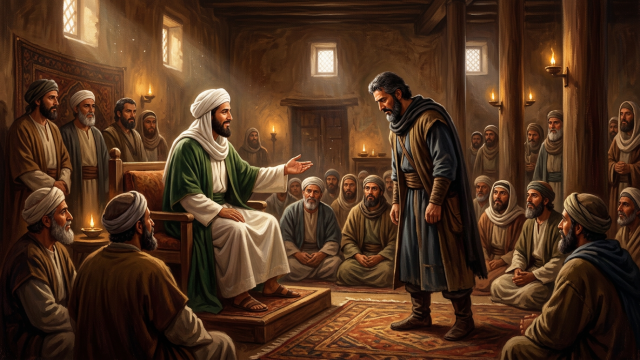
In the eighth year after the Hijrah, Khalid bin Walid made his decision. He set out for Medina. He didn't travel with a large entourage or an army. He travelled with a heart full of trepidation and a soul seeking peace. On the road, he met Amr ibn al-Aas and another companion, Uthman ibn Talha. The three of them, once staunch opponents of the Prophet, were now riding together towards submission to him. It was a powerful, humbling sight. They arrived in Medina and were taken to the Prophet's mosque. As Khalid entered, the air was thick with anticipation. The Muslims who had lost fathers and brothers at the hands of his sword looked upon him with a mixture of awe and apprehension. But the Prophet Muhammad (peace be upon him) looked upon him with mercy. Khalid bin Walid, the Sword of the Quraysh, the Unconquered General, stood before the Messenger of God. He was no longer a commander. He was a man seeking the truth. He testified, his voice clear and unwavering, "I bear witness that there is no god but Allah, and I bear witness that Muhammad is the Messenger of Allah." A smile spread across the Prophet's face. He looked at the man who had once been his greatest military threat and said, "O Khalid, I have always known you to be a man of intelligence. Had you only accepted Islam sooner, you would have been a great support to us. But I believe that you have good in you that we have not yet seen." Then, turning to those present, the Prophet said words that would define Khalid's destiny: "A man like Khalid, who has thrown away his sword in rejection of the world, cannot keep his sword hidden. Khalid is a sword. And now, this sword is drawn for God and His Messenger." He looked back at Khalid. "You are welcome. You are a noble brother and a noble son." In that moment, Khalid bin Walid was reborn. The pride, the arrogance, the thirst for tribal glory—it all melted away, replaced by a profound sense of purpose. He was no longer a sword for the Quraysh. He was a sword for God.
Chapter
02
An Uneasy Peace
It had been months since his acceptance of Islam, and though the transition was not without its complexities, he found solace in the community. The bonds of brotherhood, forged in faith, were stronger than those of blood. He was among men who once viewed him as an enemy, yet now embraced him as a brother. The irony was not lost on him.
Khalid’s thoughts were interrupted by the sound of footsteps approaching. He turned to see his brother, Walid bin Walid, with a warm smile on his face. "Khalid," Walid called, his voice carrying the same familial warmth that Khalid remembered from their childhood. "You seem deep in thought, brother."
"Perhaps," Khalid replied, returning the smile. "I was just reflecting on how much life has changed."
Walid nodded, his expression gentle. "Indeed, it has. And yet, it feels as though you have always been meant for this path."
Khalid nodded, a sense of agreement settling within him. "I find peace here, Walid. More than I ever thought possible."
Their conversation was interrupted by the arrival of Amr ibn al-Aas, his stride confident and purposeful. "Ah, the bin Walid brothers," Amr greeted with a grin. "I hope I'm not interrupting a familial moment."
"Not at all," Khalid said, clasping Amr's arm in greeting. "We were just discussing the comforts of our new lives."
Amr laughed, a sound full of camaraderie. "Comforts, indeed. Though I suspect there will be little comfort in the days to come."
Khalid’s curiosity piqued. "What do you mean?"
Amr’s expression grew serious. "There is talk of renewed conflict. The tribes are restless, and the Prophet may soon call upon us to bring them into the fold."
Khalid felt a familiar stir within him—the call to action, the thrill of purpose. "If that is the case, then we will be ready."
Walid placed a hand on Khalid's shoulder. "Ready and united. This time, we fight for something greater than ourselves."
The three men stood in silent agreement, the weight of their shared destiny settling around them. They were no longer mere warriors; they were defenders of a cause far greater than any personal ambition.
As the sun began to dip below the horizon, casting long shadows across the city, Khalid felt a sense of anticipation. The path ahead was uncertain, but for the first time in his life, uncertainty did not breed fear. It bred hope.
Later that evening, Khalid sat in his modest home, the dim light of a single lantern casting flickering shadows on the walls. He pondered the news Amr had brought, wondering what challenges lay ahead. His thoughts were interrupted by a soft knock at the door. Rising, he went to answer it, finding a young messenger standing there, his face flushed with urgency.
"Commander Khalid," the boy said, breathless. "The Prophet requests your presence at the mosque."
Khalid nodded, a sense of purpose igniting within him. "Thank you. I will come at once."
The journey to the mosque was short, but each step felt significant, heavy with anticipation. As he entered the sacred space, he saw the Prophet Muhammad (peace be upon him) surrounded by his closest companions, their expressions a mixture of concern and determination.
"Khalid," the Prophet called, gesturing for him to come forward. "We have much to discuss."
Khalid approached, bowing his head in respect. "I am here to serve, Messenger of Allah."
The Prophet's eyes, wise and compassionate, held his own. "There is news from the north. The tribes there are gathering, and their intentions are far from peaceful. We must prepare."
The room was silent, the weight of the task at hand palpable. Khalid felt the familiar stir of responsibility, the call to protect and to serve.
"We will do what is necessary," Khalid replied, his voice steady with conviction. "Tell me what you need, and it will be done."
The Prophet nodded, a faint smile playing at the corners of his lips. "I have no doubt, Khalid. You are our sword, and with you, we are stronger."
As plans were discussed and strategies formed, Khalid felt the weight of his new life settle into place. He was a warrior, yes, but now he fought for a cause that transcended personal glory. It was a cause of unity, of faith, of hope.
As the meeting concluded and the men began to disperse, Khalid lingered for a moment, his gaze catching the Prophet’s once more. In that silent exchange, he felt an understanding pass between them—a recognition of the journey they had both undertaken, the trials they had endured, and the victories yet to come.
Stepping out into the cool night air, Khalid looked up at the stars, each one a beacon of light in the vast expanse of darkness. Somewhere out there, the world awaited. And this time, Khalid bin Walid was ready to meet it, not as a conqueror of men, but as a servant of peace.
In the distance, the sound of a new dawn began to rise, promising a day of challenges and triumphs. Khalid took a deep breath, his heart full of resolve, eager to embrace the path laid out before him.
Little did he know, the world was on the cusp of a transformation, and he was destined to be a part of it—a sword drawn for truth, guided by a faith that had once seemed so foreign, but now was the cornerstone of his existence.
Chapter
03
The Path to Medina
The sun had dipped below the horizon, casting the world in hues of deep amber and shadow. The three men halted for the night, gathering around a modest fire. The flames flickered, casting dancing shadows on their faces, revealing the lines etched by years of battle and contemplation.
Khalid, ever the strategist, broke the silence. "Amr, what do you think awaits us in Medina? Do you believe we will be accepted, truly?"
Amr, a man of sharp intellect and quick wit, considered the question carefully. "Medina is a city of faith, Khalid. A city of second chances. If there is a place where we can find redemption for our past, it is there. But acceptance is not a gift; it is something we must earn."
Uthman added, his voice thoughtful, "The Prophet's message is one of mercy. If we come with sincerity, I believe we will find a place among them. And perhaps, in serving this cause, we shall find something greater than we ever sought in war."
Khalid nodded, the firelight reflecting in his eyes, a spark of determination igniting within him. "I have faced countless enemies, conquered lands, and yet, the battle within my soul is the hardest fought. But this journey... it feels like the first step towards peace."
In the silence that followed, the desert seemed to breathe with them, a living entity embracing their newfound purpose. As the stars emerged, a tapestry of light against the velvet sky, Khalid felt a profound connection to the universe, as if he were but a thread in a vast, unfolding story.
The next day, they continued their journey, each mile bringing them closer to the city that had, until recently, been the heart of their opposition. As they approached Medina, the landscape began to change. The harsh desert softened into fertile earth, the air tinged with the scent of dates and blossoms. It was a place of promise and renewal.
Upon reaching the city, they were greeted by a throng of curious onlookers. The news of their arrival had spread quickly, and the air hummed with a mixture of curiosity and apprehension. Khalid dismounted, his heart pounding in his chest. The moment he had anticipated, dreaded, and hoped for was upon him.
Inside the mosque, the atmosphere was charged with expectation. The Prophet Muhammad, peace be upon him, stood at the center, his presence a calming force amid the tension. Khalid approached, each step a testament to the transformation he had undergone.
As he stood before the Prophet, Khalid felt the weight of his past and the promise of his future converging in this singular moment. He spoke the words that would seal his fate, "I bear witness that there is no god but Allah, and I bear witness that Muhammad is the Messenger of Allah."
The Prophet's response was immediate, a gentle smile that conveyed understanding and acceptance. Khalid felt a warmth spread through him, a soothing balm for the years of inner turmoil. The Prophet's words echoed in his mind, reaffirming the path he had chosen: "You are welcome. You are a noble brother and a noble son."
As Khalid stepped back, the murmurs of the gathered crowd transformed into a chorus of acceptance. He was no longer an outsider, but a part of something greater, a community bound by faith and purpose.
The days that followed were a whirlwind of new experiences. Khalid immersed himself in the teachings of Islam, finding solace in the simplicity and profundity of its message. He listened intently to the Prophet's sermons, absorbing the wisdom that flowed from his words like a gentle river, shaping the landscape of his soul.
Among the companions of the Prophet, Khalid found camaraderie and kinship. They were warriors, scholars, and leaders, each contributing to a cause that was reshaping the world. Khalid's strategic mind, once honed for conquest, now found a new outlet in service of this faith. He was consulted on matters of defense and expansion, his insights invaluable in a time of growing influence and power.
Yet, beneath the surface of this newfound peace, a restlessness stirred within him. Khalid knew that his journey was far from over. The world beyond Medina was vast and tumultuous, and the challenges that lay ahead would test the limits of his resolve and faith.
As the sun set over the city, painting the sky in shades of gold and crimson, Khalid stood at the edge of Medina, looking out towards the horizon. Somewhere beyond those distant hills, the world awaited his return—a world eager for change, for justice, for truth.
And Khalid bin Walid, the Sword of Allah, was ready to answer that call. With a heart full of purpose and a spirit unbroken by the trials of his past, he prepared to embark on a journey that would test his mettle and faith, a journey that would define his legacy for generations to come.
The night was still, the air filled with the promise of what was to come. Khalid turned back towards the city, his path illuminated by the light of the stars, each one a beacon guiding him forward. The world was on the cusp of transformation, and Khalid was poised to be its herald, his story just beginning to unfold in the annals of history.
Chapter
04
The Sword of Allah
Khalid's eyes fell upon the Prophet's mosque, a simple structure that stood as a testament to the power of humility and devotion. As the call to prayer echoed through the streets, Khalid found himself drawn to its source, his steps quickening with a sense of urgency that he couldn't quite explain.
Inside, the Prophet Muhammad (peace be upon him) was surrounded by companions, each of them attentive and reverent as he spoke. Khalid observed from the periphery, absorbing the scene. There was a warmth in the Prophet’s words that transcended the barriers of language and custom. It was a language of the heart, and Khalid felt it resonate deep within him.
After the prayer, Khalid approached the Prophet, who greeted him with a smile that spoke volumes of forgiveness and understanding. “Khalid, I see a great future for you in the service of Islam,” the Prophet said, his voice steady and full of conviction. “Your strength and wisdom shall be a beacon for others, a testament to the might of Allah’s will.”
Khalid nodded, humbled by the trust placed in him. “I am at your service, Messenger of Allah. Guide me, and I will follow.”
The Prophet nodded, placing a hand on Khalid’s shoulder. “The time will come when your skills will be needed. For now, learn from those around you. Observe, absorb, and prepare.”
With the Prophet’s blessing, Khalid immersed himself in the life of the community. He spent his days in the company of men like Umar ibn al-Khattab and Abu Bakr, absorbing their wisdom, learning the intricacies of Islamic governance, and understanding the profound message that had drawn him to this path.
It was during one such gathering that Umar approached him, a thoughtful expression playing on his features. “Khalid,” he began, his voice a rumble like distant thunder, “I hear you are restless.”
Khalid met Umar’s gaze, seeing in it a reflection of his own unspoken desires. “I have always been a man of action, Umar. I feel the call to serve in a capacity that aligns with my nature.”
Umar nodded, his eyes narrowing slightly as he considered Khalid’s words. “The Prophet sees potential in you, as do we all. When the time is right, you will lead. Until then, patience is your ally.”
Khalid accepted this counsel with the grace of a warrior who understood the value of strategic patience. Yet, the fire within him remained undimmed, a constant reminder of the path he was destined to walk.
Some weeks later, the tranquility of Medina was pierced by news that sent ripples through its streets. The Byzantines and their allies were amassing forces at the northern borders, their intentions unmistakably hostile. The tension was palpable, a reminder that the peace they cherished was fragile, always threatened by the ambitions of empires.
In the meeting that followed, the Prophet turned to his most trusted companions, his gaze lingering on Khalid. “The Byzantines must be met with strength and resolve. Khalid, your time has come.”
Khalid’s heart surged with purpose as he accepted his commission. “I am ready, Messenger of Allah.”
The preparations that ensued were swift and efficient. Khalid, now the appointed leader, rallied the troops with a fervor that was both contagious and inspiring. He was no longer just a warrior; he was a leader of men, a guardian of a cause greater than any he had ever known.
On the eve of their departure, Khalid stood alone under the vast expanse of stars, his thoughts a tumult of anticipation and resolve. He felt the weight of his new role pressing upon him, but it was a burden he bore with pride. He was the Sword of Allah, and this was his moment to wield that power in defense of the faith he had come to embrace.
As the first light of dawn crept over the horizon, Khalid led his men out of Medina, their spirits buoyed by the promise of victory. The path ahead was fraught with challenges, but each step they took was guided by a higher purpose, a divine mission that bound them together.
The journey to the battlefield was marked by a sense of camaraderie and shared resolve. Khalid’s presence was a constant source of strength, his strategic mind already at work as he formulated plans that would outmaneuver their opponents.
As they approached the enemy lines, Khalid’s heart swelled with a sense of destiny. This was not just a battle for land or power; it was a battle for faith, for the ideals that had brought him to this point. He felt the presence of Allah with him, a guiding force that steeled his resolve and sharpened his focus.
With a cry that echoed across the ranks, Khalid drew his sword, its gleam a promise of the justice he was sworn to deliver. The men around him responded in kind, their battle cries merging into a single, powerful roar that shook the earth beneath their feet.
The clash of steel and the cries of warriors filled the air, a symphony of chaos and determination. But within that chaos, Khalid moved with the precision of a master tactician, his every decision guided by the clarity of purpose that had become his guiding light.
In the heat of battle, Khalid’s thoughts drifted to the Prophet’s words, a reminder of the responsibility he now carried. He was no longer fighting for himself or for glory; he was fighting for a legacy that would endure long after he was gone, a legacy that would shine as brightly as the stars above.
As the dust settled and the cries of victory rose around him, Khalid stood amidst the remnants of battle, his heart full of gratitude and humility. He had answered the call, and in doing so, had found his true place in the world.
Yet even as the joy of victory filled the air, Khalid knew that this was only the beginning. The challenges ahead were vast, and the journey far from over. But he was ready, his spirit unbroken, his faith a beacon that would guide him through whatever lay ahead.
With a final glance at the battlefield, Khalid turned his gaze towards the horizon, where the promise of new adventures awaited. The world was changing, and with it, the role he was destined to play. And as the Sword of Allah, he was ready to meet that destiny with courage and conviction.
The world was vast, full of possibilities and dangers, but Khalid knew that as long as he held fast to his faith, he would never walk alone. The journey continued, and with each step, he was writing a story that would echo through the ages, a testament to the power of belief and the legacy of the Sword of Allah.
Cast of Characters
Khalid bin waleed
ProtagonistThe air around Medina tasted of dust and tension. For twenty long days and nights, the city had been under siege. A vast confederacy of enemies—ten thousand strong—had marched to wipe the nascent Muslim community from the face of the earth. They were stopped not by a wall of stone, but by a trench, a Persian-style defense dug on the advice of Salman the Persian. It was a tactic utterly alien to the Arabs of the desert. On the other side of that trench, frustration festered like an open wound. And no one felt that frustration more keenly than Khalid bin Walid. He sat astride his horse, his dark eyes scanning the seemingly impassable ditch. He was the greatest general Arabia had ever produced. He had never known defeat. His name alone was enough to send a chill down the spine of any foe. And yet, here he was, camped with the Quraysh and their allies, staring at a ditch. They couldn't cross it. Their horses, the very instruments of their power, were useless against it. They had resorted to taunts, to archery duels, to waiting. It was beneath him. Khalid was a man of action, of fire and blood and the terrifying, glorious chaos of the charge. This static waiting gnawed at his soul. He would watch the Muslim defenders on the other side, and his gaze would inevitably find one man. A man who wasn't fighting, but organizing, praying, and inspiring. Muhammad, the Messenger of God. From his position among the Quraysh, Khalid had heard the descriptions: a sorcerer, a madman, a poet. But from across the trench, he saw none of that. He saw a leader whose authority was not born of a tribe or a sword, but of something far more profound. He saw men who, just a few years prior, were his own kin and allies, now willing to die for this man and his singular message: La ilaha illallah (There is no god but Allah). A thought, sharp and unwelcome, pierced his mind. What if he is right? He shook it away. He was Khalid bin Walid. He was here to fight. Then came the night of the storm. A howling, freezing wind from the desert tore through the confederate camp. It snuffed out their cooking fires, sent their tents flying like panicked birds, and filled the air with biting sand. In the chaos, the alliance crumbled. The different tribes, suspicious and weary, abandoned the siege, melting away into the darkness. By morning, the vast army was gone. The siege was over. The Muslims had won without a single major battle. As the Quraysh forces retreated, Khalid lingered for a moment, looking back at the city he had failed to conquer. He didn't see a military defeat; he saw a divine sign. The storm, the wind, the collapse of the alliance—it felt too perfect, too purposeful. A powerful, unnamed emotion churned in his chest, a mixture of humility and wonder he had never felt on any battlefield. The journey back to Mecca was a long one. Khalid was silent, his thoughts a battlefield of their own. He was a man who had built his identity on his prowess, his loyalty to his clan, and his enmity towards Muhammad. To question that was to question himself. Not long after, the Treaty of Hudaybiyyah was signed. A ten-year truce was established. It was a strategic victory for the Muslims, a peace that allowed them to grow. For Khalid, it was a period of agonizing introspection. He would talk to his brother, Walid bin Walid, who had already accepted Islam. Walid would speak of the justice of the faith, of its clarity, of its call to one God. Khalid would listen, his heart softening, his mind wrestling. The final crack in his resistance came not from a conversation, but from a person. His close friend, Amr ibn al-Aas, another formidable leader who had not yet embraced Islam, was also contemplating the journey. They met and spoke of their doubts. If Amr, a man he respected, was feeling this pull, could it be that he was not alone in his confusion? Could it be that the truth was simply… true? In the eighth year after the Hijrah, Khalid bin Walid made his decision. He set out for Medina. He didn't travel with a large entourage or an army. He travelled with a heart full of trepidation and a soul seeking peace. On the road, he met Amr ibn al-Aas and another companion, Uthman ibn Talha. The three of them, once staunch opponents of the Prophet, were now riding together towards submission to him. It was a powerful, humbling sight. They arrived in Medina and were taken to the Prophet's mosque. As Khalid entered, the air was thick with anticipation. The Muslims who had lost fathers and brothers at the hands of his sword looked upon him with a mixture of awe and apprehension. But the Prophet Muhammad (peace be upon him) looked upon him with mercy. Khalid bin Walid, the Sword of the Quraysh, the Unconquered General, stood before the Messenger of God. He was no longer a commander. He was a man seeking the truth. He testified, his voice clear and unwavering, "I bear witness that there is no god but Allah, and I bear witness that Muhammad is the Messenger of Allah." A smile spread across the Prophet's face. He looked at the man who had once been his greatest military threat and said, "O Khalid, I have always known you to be a man of intelligence. Had you only accepted Islam sooner, you would have been a great support to us. But I believe that you have good in you that we have not yet seen." Then, turning to those present, the Prophet said words that would define Khalid's destiny: "A man like Khalid, who has thrown away his sword in rejection of the world, cannot keep his sword hidden. Khalid is a sword. And now, this sword is drawn for God and His Messenger." He looked back at Khalid. "You are welcome. You are a noble brother and a noble son." In that moment, Khalid bin Walid was reborn. The pride, the arrogance, the thirst for tribal glory—it all melted away, replaced by a profound sense of purpose. He was no longer a sword for the Quraysh. He was a sword for God. From that day forward, he would not fight for lineage or for victory. He would fight for a cause greater than any empire. He would lead armies in Iraq and Syria, outmaneuvering the Byzantines and the Persians with a brilliance that seemed almost supernatural. He would never lose a battle. But now, every victory was a testament to the faith he had once opposed. The story of Khalid bin Walid is not just the story of a great general. It is the story of a man who, after a lifetime of opposition, had the courage to face the truth. It is the story of how the fiercest enemy became the most loyal defender, how the man who once sought to extinguish the light of Islam became one of its most brilliant swords, forever gleaming in the service of Allah.
Reader Comments
13 readers
Sign in or create an account to leave a comment.
No comments yet. Be the first to share your thoughts!
The End
Life of Khalid Bin Waleed
by Muhammed Qasim Rabbani
4,462 words · 4 chapters · 1 characters